Herniated Disc Treatment and Pain Relief in Green Bay
When you’re told you have a herniated disc, the diagnosis can feel overwhelming. It often comes with persistent pain and a heavy cloud of uncertainty about what to do next. The good news is that for most people in Green Bay, the best treatment for a herniated disc begins with effective, non-surgical care. In fact, the vast majority of our patients find lasting relief without ever needing an invasive procedure.
At Cornerstone Chiropractic, our goal is to help you understand your options. Whether you’re dealing with sciatica, neck pain, or debilitating back pain, we focus on treatments like chiropractic care and spinal decompression that relieve nerve pressure and empower your body’s natural healing process. If you’re looking for a trusted chiropractor in Green Bay, WI, you’ve come to the right place.
Finding Relief for Herniated Disc Pain in Green Bay
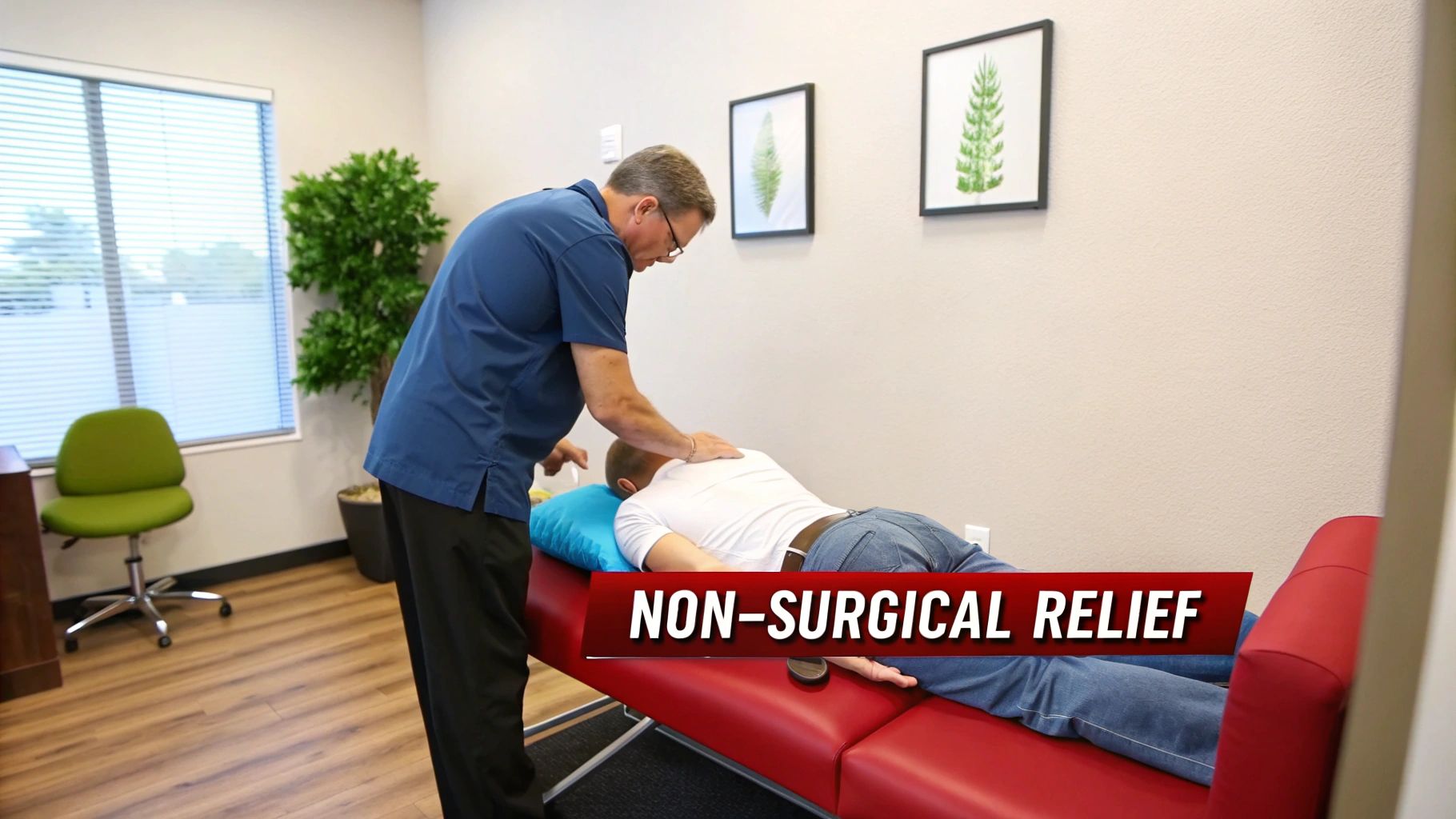
If you’re searching for a way out from debilitating back pain, neck pain, or sciatica, you are far from alone. A herniated disc can completely disrupt your life, making everything from sitting at your desk in Green Bay to playing with your kids feel impossible. That constant ache, the sharp, radiating pain, or the frustrating numbness can leave you wondering if surgery is your only path forward.
Thankfully, for most of our patients, it rarely is.
At Cornerstone Chiropractic, we’ve helped countless Green Bay residents find lasting relief using proven, patient-first solutions that get to the root cause of disc pain—all without drugs or surgery. This guide is here to explain your options clearly, comparing effective conservative care against surgery so you can make a confident, informed decision about your health.
Herniated Disc Treatment Approaches at a Glance
This quick comparison table summarizes the primary treatment paths, helping you understand your options for herniated disc relief.
| Treatment Approach | Best For | Primary Goal | Invasiveness |
|---|---|---|---|
| Conservative Care | Most herniated disc cases without severe neurological symptoms (e.g., foot drop). | Reduce inflammation, alleviate nerve pressure, and restore spinal function to promote natural healing. | Non-Invasive |
| Surgical Intervention | Cases with severe “red flag” symptoms or persistent pain after 6-12 weeks of dedicated conservative care. | Physically remove the disc material that is compressing the nerve root or spinal cord. | Invasive |
The distinction between these two paths is critical. The entire goal of conservative care—which includes treatments like chiropractic adjustments and spinal decompression—is to create the ideal environment for your body to repair the damaged disc on its own. As a trusted chiropractor in Green Bay, Dr. Bill Binsfeld always prioritizes these methods first.
For the overwhelming majority of patients, a dedicated conservative care plan provides significant, lasting relief and helps them avoid unnecessary surgical procedures. The key is to address the mechanical pressure on the nerve.
We’ll dive into how innovative treatments like non-surgical spinal decompression and SoftWave Therapy offer powerful, effective relief. Understanding how to relieve lower back pain naturally is an important first step. This guide provides a clear, evidence-based path to help you reclaim your health right here in Green Bay.
Understanding How a Herniated Disc Causes Pain

To find the best treatment for your pain, it helps to first understand the problem. A herniated disc is a mechanical issue. Grasping its simple but powerful impact on your body is the first step toward finding real, lasting relief. Once you can visualize what’s happening in your spine, the logic behind effective treatments like chiropractic care becomes crystal clear.
Your spine is an incredible structure, built from strong bones called vertebrae stacked one on top of the other. Tucked between each of these bones is a soft, rubbery cushion called an intervertebral disc. These discs are your body’s natural shock absorbers, allowing you to bend, twist, and move without bone grinding on bone.
Think of each disc like a jelly donut. It has a tough, fibrous outer layer (the annulus fibrosus) and a soft, gel-like center (the nucleus pulposus). A herniated disc happens when a tear or weak spot in that tough outer casing allows some of the inner “jelly” to squeeze out.
The Source of Pain: Nerve Compression
This displaced disc material doesn’t have much room to go. It often presses directly on the highly sensitive spinal nerves that exit the spinal cord at each level. This is the root cause of the intense pain so many people here in Green Bay feel.
It’s this direct pressure—or nerve compression—that kicks off a cascade of debilitating symptoms. The specific symptoms you feel depend entirely on which nerve is being pinched. Our Green Bay clinic has a wealth of information you can explore to learn more about the specifics of herniated disc causes and treatments.
The location of the herniation dictates the path of the pain. A herniated disc in the lower back pinches the sciatic nerve, causing sciatica, while one in the neck can send pain radiating down your arm.
For example, the sciatic nerve is the longest in your body, running from your lower back down through your hips, buttocks, and each leg. When a lumbar herniated disc compresses this nerve, it triggers the classic, agonizing symptoms of sciatica.
Common Symptoms of Nerve Compression
The pressure from a herniated disc can show up in several ways, and it’s rarely just localized pain. The signals sent by the compressed nerve get scrambled, leading to a whole range of issues.
Patients often describe their symptoms as:
- Radiating Pain: A sharp, burning, or shooting pain that travels along the nerve’s pathway. For a lumbar herniation, this is classic sciatica felt in the leg. For a cervical herniation, it travels into the shoulder and arm.
- Numbness or Tingling: That frustrating “pins and needles” sensation in the area supplied by the nerve, like your foot or hand.
- Muscle Weakness: Difficulty lifting your foot (foot drop), struggling to grip objects, or a scary feeling that your leg might just “give out.”
These symptoms are direct messages from your body telling you a nerve is in trouble. This is exactly why the best treatment for a herniated disc must focus on relieving that pressure. At Cornerstone Chiropractic, our goal is to address this core mechanical problem, which in turn calms down the symptoms and allows your body’s natural healing process to finally take over.
Comparing Conservative Treatments for Herniated Discs
When you’re dealing with the constant, draining pain of a herniated disc, the sheer number of treatment options can feel overwhelming. The good news? For most people right here in Green Bay, the best path forward doesn’t involve a scalpel. Conservative, non-invasive therapies are incredibly effective at relieving pressure, dialing down pain, and helping your body heal the way it’s supposed to.
At Cornerstone Chiropractic, we believe an educated patient gets the best results. Let’s break down the most effective conservative treatments available, comparing how they work, who they’re for, and what you can realistically expect. Think of this not just as a list, but as a practical guide to reclaiming your life from disc pain.
Chiropractic Care: The Foundation of Spinal Health
Chiropractic care is often the first stop for disc-related pain, and for good reason. It gets right to the heart of the mechanical issues that cause disc injuries in the first place. A herniated disc rarely happens in a vacuum; it’s usually the end result of improper spinal alignment and dysfunctional movement patterns that put uneven stress on your discs day after day.
Gentle, precise chiropractic adjustments are all about restoring proper motion to the spinal joints. This isn’t about forceful “cracking,” but controlled techniques that improve your spine’s alignment and calm irritated nerves. By correcting the underlying biomechanics, chiropractic care helps take the direct pressure off the herniated disc, giving it the space it needs to heal.
- How It Works: Dr. Bill Binsfeld uses specific adjustments to restore mobility to stuck spinal segments. This helps to decrease inflammation, improve nerve function, and create a much better healing environment for the disc.
- Ideal Patient: Someone with localized or radiating pain from a herniated disc who wants to fix the root structural cause of their problem. It’s a fantastic starting point for almost all disc injury cases that don’t show “red flag” symptoms.
- Expected Timeline: Many patients feel some relief within the first few visits as inflammation starts to die down. However, lasting correction and stability usually require a dedicated treatment plan over several weeks to retrain the spine and its supporting muscles.
Non-Surgical Spinal Decompression: A Targeted Approach to Disc Healing
While chiropractic adjustments restore overall spinal function, non-surgical spinal decompression zooms in on the damaged disc itself. Think of it as creating a healing vacuum. This therapy is one of the most powerful conservative tools we have for severe, stubborn disc pain like sciatica.
During a session, you lie comfortably on a specialized table that gently and precisely distracts, or pulls, the spine. This slow, controlled motion creates negative pressure right inside the disc. This vacuum effect can actually help draw the bulging or herniated material back into the disc and away from that pinched nerve root.
Key Differentiator: Spinal decompression directly targets the internal pressure of the disc. This negative pressure not only helps retract the herniated material but also pulls in oxygen, water, and nutrients—all critical for disc healing but often blocked by inflammation.
This is a huge distinction. While other therapies manage symptoms or strengthen surrounding areas, spinal decompression is engineered to address the internal disc injury head-on. Most patients find the sessions to be quite relaxing and often report immediate, though temporary, relief after just the first treatment.
Comparing Decompression and Adjustments
| Treatment | Primary Mechanism of Action | Main Goal | Best Suited For |
|---|---|---|---|
| Chiropractic Adjustments | Restores proper motion to spinal joints. | Improve overall spinal alignment and nerve function. | Addressing foundational biomechanical issues causing disc stress. |
| Spinal Decompression | Creates negative intradiscal pressure. | Retract herniated material and promote nutrient flow. | Directly targeting the injured disc to relieve nerve compression. |
Physical Therapy: Building Strength and Stability
Physical therapy (PT) plays a crucial, complementary role in getting you back on your feet. While chiropractic and decompression work to relieve pressure on the disc and nerves, PT is all about building a strong support system around your spine. A strong, stable core acts like a natural brace for your back, protecting your discs from future injury.
A physical therapist will guide you through specific exercises designed to strengthen the deep abdominal and back muscles. They’ll also work on improving your flexibility and teach you proper body mechanics for daily life—like how to lift a box or sit at your desk—to stop the cycle of re-injury.
- How It Works: PT uses targeted exercises to build muscle endurance and stability around the spine, which takes the load off your intervertebral discs.
- Ideal Patient: Anyone recovering from a disc injury. It’s absolutely vital for those with muscle weakness or poor posture, as it builds long-term resilience.
- Expected Timeline: Progress is gradual and hinges on your consistency. Patients typically notice improved strength and stability over a period of 6 to 12 weeks.
The data is overwhelmingly in favor of this approach. Landmark research like the Spine Patient Outcomes Research Trial (SPORT) found that for many patients, the long-term results of conservative treatments match those of surgery. Even more impressively, a comprehensive review of over 2,200 patients showed a 70.39% spontaneous disc resorption rate with conservative care alone. For our patients in Green Bay, this data confirms why starting with evidence-based chiropractic and rehabilitative care is such a powerful first step. Discover more about the high success rates of non-surgical herniated disc treatment on limitlesspts.com.
SoftWave Therapy: Accelerating Tissue Repair
SoftWave Therapy is a modern approach that uses unfocused acoustic waves to kickstart your body’s own healing and regeneration processes at a cellular level. When applied to the area around a herniated disc, these waves can significantly reduce inflammation, boost blood flow, and activate your own stem cells to repair damaged tissues, including the ligaments and muscles supporting the spine.
This therapy isn’t about treating the disc herniation directly. Instead, it’s about healing the inflamed and damaged soft tissues surrounding the injury. By calming this secondary damage, SoftWave can dramatically reduce pain and improve mobility, which in turn makes it easier for you to engage in other therapies like chiropractic adjustments and PT.
At Cornerstone Chiropractic, we often integrate SoftWave Therapy into our herniated disc treatment plans. It creates a powerful synergistic effect, helping to speed up the results you get from spinal decompression and chiropractic care by creating a healthier, less inflamed environment where true healing can happen. It’s another tool that helps our Green Bay patients get better, faster.
When to Consider Surgery for a Herniated Disc
Let’s be clear: the vast majority of people with a herniated disc get lasting relief without ever seeing the inside of an operating room. At Cornerstone Chiropractic, our entire approach is built around helping our Green Bay patients avoid invasive procedures.
But it’s just as important to be honest about the rare times when surgery becomes the most responsible and necessary next step. This isn’t about fear; it’s about being fully informed. The conversation around surgery usually begins only after a dedicated effort with conservative care hasn’t produced the results we need, or if specific, serious symptoms emerge.
Identifying Red Flag Symptoms
While most herniated disc pain is manageable, there are a few symptoms that signal a true medical emergency. If you experience any of the following, please go to an emergency room for an immediate evaluation.
These “red flags” can point to a serious condition called cauda equina syndrome, where the nerve roots at the very end of your spinal cord are being severely compressed.
- Loss of Bowel or Bladder Control: Any new or sudden inability to control your urination or bowel movements.
- Saddle Anesthesia: A strange numbness or loss of feeling in the areas that would touch a saddle—your inner thighs, groin, and buttocks region.
- Progressive Leg Weakness: Weakness in one or both legs that is noticeably getting worse. This includes a condition called foot drop, where you suddenly find it difficult to lift the front of your foot when you walk.
These symptoms are very rare, but they are not something to wait on. Part of our commitment to your health is ensuring you know exactly when to seek immediate medical attention.
When Conservative Care Isn’t Enough
Outside of a medical emergency, the primary reason to think about surgery is simple: a structured, consistent conservative care plan just isn’t working. We typically recommend a dedicated trial of 6 to 12 weeks.
If you’ve been consistent with treatments like chiropractic care, spinal decompression, and physical therapy but are still dealing with severe, life-altering pain, a surgical consultation is a logical next move. Persistent, unrelenting pain that simply doesn’t respond is a clear sign that a different path may be needed.
The goal of conservative care is to see steady, measurable progress. If your pain and function are not improving after a reasonable period, a consultation with a spine surgeon is a logical and prudent step to discuss other options.
This decision tree gives a great visual of the typical journey. It shows how nearly everyone starts with conservative care, and surgery is only considered down the line.
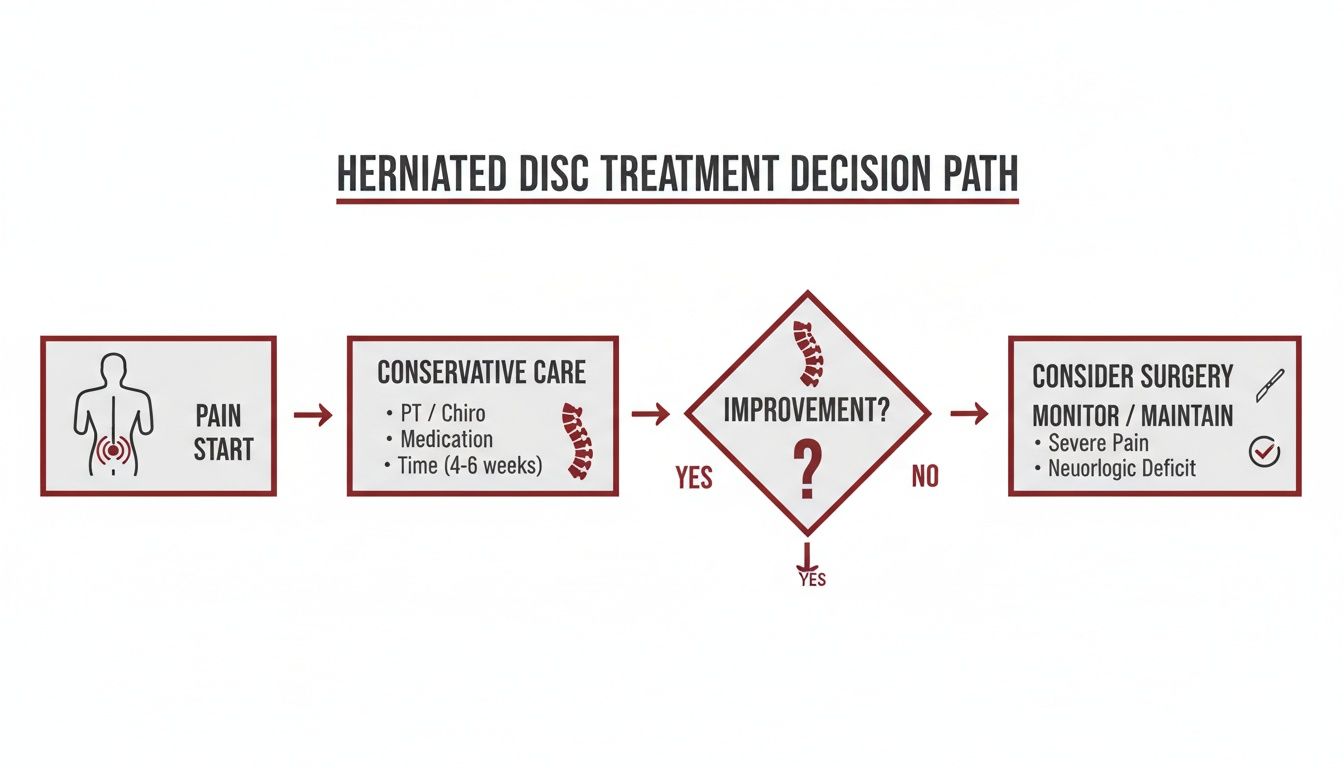
As you can see, the path for almost every patient begins with non-invasive care. Surgery is reserved for specific, well-defined situations.
Understanding Common Surgical Procedures
If surgery does become the recommended path, one of the most common procedures you’ll hear about is a microdiscectomy. This is a minimally invasive surgery where a surgeon makes a tiny incision to remove just the piece of the disc that’s pressing on the nerve. The idea is to relieve the pressure while saving as much of the healthy disc as possible.
It’s critical to remember that surgery has its own risks and a significant recovery period. While a microdiscectomy has a high success rate (80-90%) for relieving sciatic leg pain, it’s not a guaranteed cure for back pain, and reoperation rates can be as high as 7-18%.
This is precisely why a conservative-first approach is so vital. A comprehensive global analysis confirmed that while surgery is effective for the right candidate, conservative care produces excellent long-term results. In fact, some data suggests that a staggering 90-98% of patients can avoid the knife entirely by starting with the right non-surgical treatments. Read the full research about these powerful findings on ncbi.nlm.nih.gov.
For anyone in the Green Bay area, the best first step is a thorough evaluation here at Cornerstone Chiropractic. We can determine if your condition is a good fit for our effective, non-surgical treatments or, if needed, guide you to the right specialist.
Your Path to Recovery at Cornerstone Chiropractic

Deciding to finally get help for a herniated disc is a huge first step. We know that, and we also know that understanding what comes next can make all the difference. At Cornerstone Chiropractic, we’ve built our entire process to be clear, reassuring, and completely focused on you.
From the moment you walk into our Green Bay clinic, our mission is to ease your anxiety and build your confidence in the road ahead. We understand—you’re not just a collection of symptoms. You’re a person whose life has been turned upside down by pain, and we’re here to partner with you on getting it back.
Your First Visit: A Foundation for Healing
Everything starts with a detailed consultation and examination with Dr. Bill Binsfeld. This first appointment is the most important one because we don’t believe in one-size-fits-all solutions for something as complex as a herniated disc.
During this visit, we focus on two critical things: hearing your story and performing a deep-dive assessment.
- Understanding Your Experience: We’ll talk about your symptoms, how long you’ve been dealing with the pain, what makes it better or worse, and how it’s really impacting your daily life here in Green Bay.
- Comprehensive Examination: Dr. Binsfeld will perform a thorough neurological and orthopedic evaluation to zero in on the exact source of your pain and identify the specific nerve being pinched by the disc herniation.
This detailed process allows us to create a precise diagnosis and confidently rule out any other issues that might be causing your discomfort.
Crafting Your Personalized Treatment Plan
Once we have a crystal-clear picture of what’s going on, we’ll sit down with you and explain everything in plain, simple language. We’ll show you what’s happening in your spine and then map out a personalized treatment plan designed specifically for your herniated disc.
This isn’t a generic list of services. It’s a strategic combination of the therapies best suited to get you results. For many of our Green Bay patients, this often means a powerful blend of:
- Chiropractic Adjustments: To restore proper motion to your spine and relieve the foundational stress that’s putting pressure on your discs.
- Non-Surgical Spinal Decompression: To directly target the injured disc, create negative pressure, and gently pull that herniation off the nerve.
- SoftWave Therapy: To supercharge tissue repair, knock down stubborn inflammation, and amplify your body’s natural healing ability.
We’ll walk you through the role each therapy plays in your recovery and what you can expect from every single session.
At Cornerstone Chiropractic, your treatment plan is a collaborative effort. We make sure you understand the “why” behind every recommendation, empowering you to be an active participant in your own healing.
What Makes Our Green Bay Clinic Different
Choosing a chiropractor in Green Bay, WI, is about more than just finding someone to treat your symptoms. It’s about finding a partner you can trust with your health. We pride ourselves on creating a welcoming, family-focused environment where you feel supported from day one.
Our commitment to our patients includes:
- A Welcoming Environment: We treat you like family because, to us, you are. Our clinic is a place where you can feel comfortable and confident in the care you’re receiving.
- Insurance-Friendly Care: Dealing with insurance can be a headache. We handle it for you. Our office is in-network with many providers, and we take care of the benefit verification process to make getting started simple.
- Clear, Honest Communication: You will never be left in the dark about your condition or your care. We believe in total transparency and will always provide clear, honest guidance.
Your recovery is a journey, and our mission is to provide the best treatment for herniated disc pain by offering compassionate, evidence-based care that helps our Green Bay neighbors move better, feel better, and get back to living healthier lives.
Your Questions About Herniated Disc Treatment Answered
When you’re dealing with the pain of a herniated disc, questions and concerns are completely normal. Making an informed choice about your care is the first step toward getting better. Here, Dr. Bill Binsfeld addresses some of the most common questions our Green Bay patients have, giving you the clear, straightforward answers you need to move forward with confidence.
How Long Does Herniated Disc Recovery Take with Chiropractic Care?
This is the big question, and the honest answer is: it’s different for everyone. Your recovery timeline will depend on how severe the herniation is, how long you’ve been dealing with the symptoms, and your overall health. There’s no one-size-fits-all calendar for healing.
That said, here at our Green Bay clinic, most people start to feel a significant drop in pain and inflammation within the first few weeks of consistent care. We’re always aiming for steady, noticeable improvement right from the start.
While the disc and its surrounding tissues may take several months to fully heal and stabilize, our immediate goal with treatments like spinal decompression is to get you relief and restore your function as quickly as we can.
Is Non-Surgical Spinal Decompression Painful?
We get this question a lot, and it’s an understandable fear. But the answer is a firm no. Non-surgical spinal decompression is designed from the ground up to be gentle, comfortable, and incredibly relieving.
As the specialized table does its work, you’ll feel a light, soothing stretch in your spine—that’s it. The whole system is computer-controlled, applying precise and gentle forces that create negative pressure inside the disc. In fact, many of our patients in Green Bay find the sessions so relaxing they can rest or even drift off to sleep.
The entire experience is focused on comfort. We’re trying to decompress your spine and take the pressure off, not add more stress. The only sensation should be a gentle pull as that pressure is finally lifted from the injured disc and pinched nerve.
Can a Herniated Disc Heal Without Surgery?
Absolutely. Not only is it possible, it’s the most common outcome. A large body of research confirms that the vast majority of herniated discs heal without ever needing surgery. The body has an amazing ability to repair itself, and studies have shown that the herniated disc material often shrinks or gets reabsorbed over time.
But waiting for that to happen on its own can be a long, painful, and uncertain road. That’s where professional conservative care makes all the difference.
The best treatment for a herniated disc is one that creates the perfect environment for your body to speed up that natural healing process.
- Chiropractic Care: We focus on restoring proper movement and mechanics in your spine, which takes direct mechanical stress off the injured disc.
- Spinal Decompression: This therapy actively pulls pressure off the disc and nerve, allowing a flood of oxygen and vital nutrients into the area to accelerate repair.
- SoftWave Therapy: By reducing inflammation and stimulating cellular repair in the surrounding ligaments and muscles, we strengthen the support system around the disc.
By combining these therapies, we don’t just sit back and hope the disc heals—we actively guide it. This approach is designed to deliver faster pain relief, restore your ability to move, and reduce the odds of future problems, helping you get back to your life in Green Bay much sooner.
Your journey to a pain-free life begins with an accurate diagnosis and a plan built just for you. At Cornerstone Chiropractic, Dr. Bill Binsfeld and our team are dedicated to providing the Green Bay community with effective, non-surgical solutions for herniated disc pain.
Schedule Your Consultation Today and Discover Your Path to Relief at drbillbinsfeld.com