How to Relieve Lower Back Pain Naturally in Green Bay, WI
When that sharp twinge hits your lower back while you’re lifting a box, or you wake up with that familiar, dull ache, your first thought is probably, “How do I make this stop right now?” The good news is that you don’t always need to rush for medication. Your first line of defense is right at home.
Simple, immediate self-care can work wonders to calm things down, ease muscle spasms, and give your body a much-needed break to begin the healing process.
Finding Immediate Relief From Lower Back Pain at Home
You’re not alone in this. Back pain is a major issue for people everywhere, including right here in Green Bay. In 2020, an incredible 619 million people worldwide were dealing with low back pain, making it the top cause of disability on the planet. For those of us juggling demanding jobs, family life, and active hobbies in Wisconsin, that statistic feels very real. It’s a problem that tends to affect women more often than men, usually peaking between the ages of 50-55. You can read more about these back pain statistics to see just how widespread this issue is.
Heat vs. Ice: Which is Better for Your Back?
One of the first questions patients ask me is whether to grab a heating pad or an ice pack. The answer depends entirely on what kind of pain you’re feeling.
- Ice for New Injuries: If your pain just started (within the last 48-72 hours) and feels sharp, swollen, or inflamed, ice is your go-to. Cold therapy helps constrict blood vessels, which is great for reducing swelling and numbing that acute, sharp pain.
- Heat for Chronic Aches: For that stubborn, muscular soreness or chronic stiffness that doesn’t involve swelling, heat is your best friend. A heating pad or a warm bath boosts blood flow, which helps relax those tight, tense muscles and soothe discomfort.
The rule of thumb is simple: Ice calms down new injuries, while heat relaxes old complaints. Just remember to never apply heat or ice directly to your skin—always wrap the pack in a thin towel first.
This simple flowchart can help you decide in a pinch.
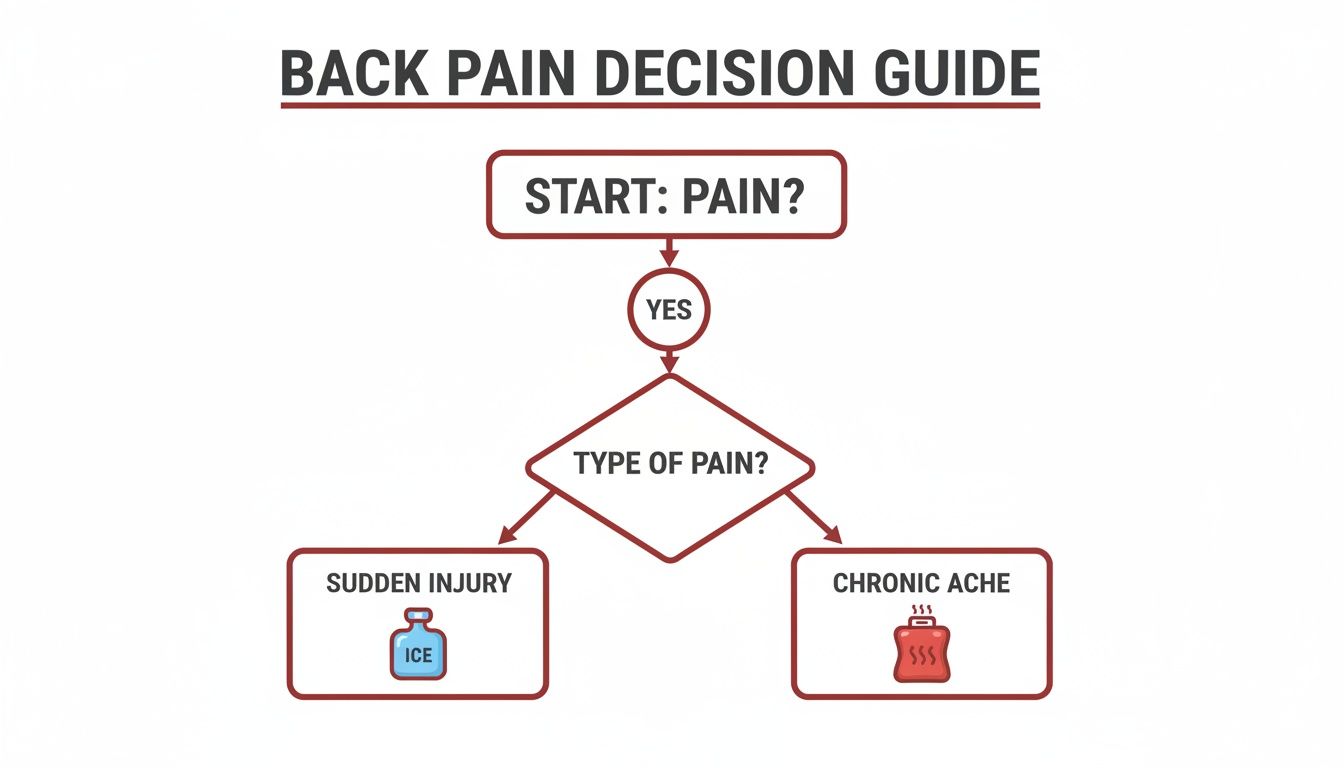
When the pain is sudden and sharp, ice is the clear winner. For a persistent, dull ache, turn up the heat.
For a quick reference, here are the best at-home strategies to use the moment pain strikes.
Quick-Start Relief Techniques At a Glance
| Technique | Best For | How to Apply | Duration |
|---|---|---|---|
| Ice Pack | Sudden, sharp pain; new injuries (less than 72 hours old); visible swelling. | Wrap the ice pack in a thin towel. Apply directly to the most painful area. | Apply for 15-20 minutes at a time, several times a day. |
| Heating Pad | Chronic muscle aches, stiffness, and soreness (no swelling). | Use a heating pad on a low to medium setting or take a warm bath/shower. | Use for 15-20 minutes at a time. Can be used before gentle stretching. |
| Pillows Under Knees | General lower back strain and muscle tension. | Lie flat on your back and place one or two pillows under your knees to flatten your spine. | Rest in this position for 10-15 minutes or as long as it feels comfortable. |
| Pillow Between Knees | Pain on one side; hip or pelvic discomfort; sciatic-type pain. | Lie on your side (painful side up is often best) with your knees slightly bent. Place a firm pillow between your knees. | Hold this position for as long as needed to feel relief, including when you sleep. |
These techniques are designed to provide immediate comfort and create a better environment for your body to start healing.
Simple Positions to Instantly Relieve Pressure
Sometimes, the best thing you can do is get off your feet and take the pressure off your lumbar spine. But how you lie down matters. Instead of curling up in a way that might make things worse, try one of these positions.
Lying on your back with a couple of pillows propped under your knees is a classic for a reason. It helps gently flatten your lower back against the floor, allowing those overworked muscles to finally relax.
Another great option is to lie on your side with a pillow tucked between your knees. This simple trick helps keep your hips, pelvis, and spine in a neutral, aligned position, which can provide a surprising amount of relief.
These at-home strategies are your crucial first steps. They are all about managing the immediate symptoms and giving your body a fighting chance. Of course, if the pain doesn’t let up or starts getting worse, it’s a clear sign you need to get it checked out. A chiropractor in Green Bay, WI can help figure out the root cause and build a plan for lasting recovery.
Building a Stronger Back With Gentle Stretches and Exercises
Quick-fix techniques are great for calming a painful flare-up, but getting lasting freedom from lower back pain means building a stronger, more flexible spine. When the muscles supporting your back are weak and tight, you’re left vulnerable to strain from the simplest everyday movements. The real key is gentle, consistent exercise that creates a resilient back capable of handling life’s demands.

This isn’t about hitting the gym for an intense workout. The goal here is to gently mobilize your spine, activate your deep core muscles, and improve your flexibility without triggering more pain.
Think of your core—the network of abdominal and back muscles—as your body’s own natural support system. When this system is strong, it takes a massive amount of pressure off your delicate spinal discs and joints.
Foundational Stretches to Gently Mobilize Your Spine
When your back is stiff and aching, the last thing you want to do is force it into a position that hurts. These stretches are specifically designed to be safe and effective, even for a sensitive back. Remember to move slowly, breathe deeply, and never push into sharp pain.
- Cat-Cow Stretch: Get on your hands and knees, with wrists under your shoulders and knees under your hips. As you breathe in, let your belly drop down as you look up, creating a gentle curve in your spine (Cow pose). As you breathe out, round your spine up toward the ceiling and tuck your chin to your chest (Cat pose). Let this movement flow for 10-15 repetitions to gently warm up the spine.
- Knee-to-Chest Stretch: Lie down on your back with your knees bent and feet flat on the floor. Carefully bring one knee toward your chest, using your hands to hold it there for 20-30 seconds. You should feel a nice, comfortable stretch in your lower back and hip. Do the same on the other side, then finish by hugging both knees to your chest.
- Piriformis Stretch: Still on your back, cross your right ankle over your left knee. Now, gently pull your left thigh toward you until you feel a good stretch deep in your right glute. Hold it for 30 seconds, then switch sides. This one is fantastic for targeting the piriformis muscle, which can cause sciatica-like pain when it gets too tight.
The goal is always gentle mobilization, not aggressive pulling. If you’re also feeling stiffness higher up, our guide on how to relieve neck pain has some great tips that complement this routine for overall spinal health.
Activating Your Core for Long-Term Support
Once your back feels a bit more mobile, it’s time to wake up the deep core muscles that truly stabilize your spine. These exercises aren’t about building a six-pack; they’re about teaching your body how to support itself from the inside out.
The power of movement is huge. In fact, exercise therapy can cut back pain by 20-30% more effectively than doing nothing, with simple activities like walking and yoga being especially helpful. You can read more about these lower back pain forecasts to see just how crucial movement is to the solution.
Key Takeaway: A strong core isn’t about looks; it’s about function. It acts like a protective brace for your lumbar spine, absorbing shock and preventing the tiny micro-injuries that can build up into chronic pain.
Simple Exercises to Build a Stable Foundation
Start with just a few reps and focus on perfect form. Quality is much more important than quantity here.
- Bird-Dog: Begin on your hands and knees. Extend your right arm straight out in front of you while extending your left leg straight back, keeping your hips and shoulders level. Hold for just a few seconds, then return to the starting position. Alternate sides, aiming for 10-12 repetitions per side. This is a fantastic move for improving balance and strengthening your entire back.
- Glute Bridges: Lie on your back with your knees bent, feet flat on the floor, and arms resting by your sides. Squeeze your glutes and lift your hips off the floor until your body makes a straight line from your shoulders to your knees. Pause for a moment at the top, then slowly lower yourself back down. Shoot for 10-15 repetitions.
Building strength doesn’t happen overnight, so be patient with your body. If you’re not sure about your form or if any of these moves cause pain, it’s always best to get a professional opinion. A chiropractor in Green Bay, WI, can assess your specific situation and give you a personalized exercise plan that is both safe and effective for your recovery.
How Your Daily Habits Impact Your Spinal Health
The gentle stretches and core exercises we’ve covered are fantastic, but their benefits can be undone by the small, repetitive strains we put on our backs all day long. The root cause of stubborn lower back pain often isn’t one dramatic injury. It’s the slow, cumulative effect of our daily routines—how we sit, stand, lift, and even drive.
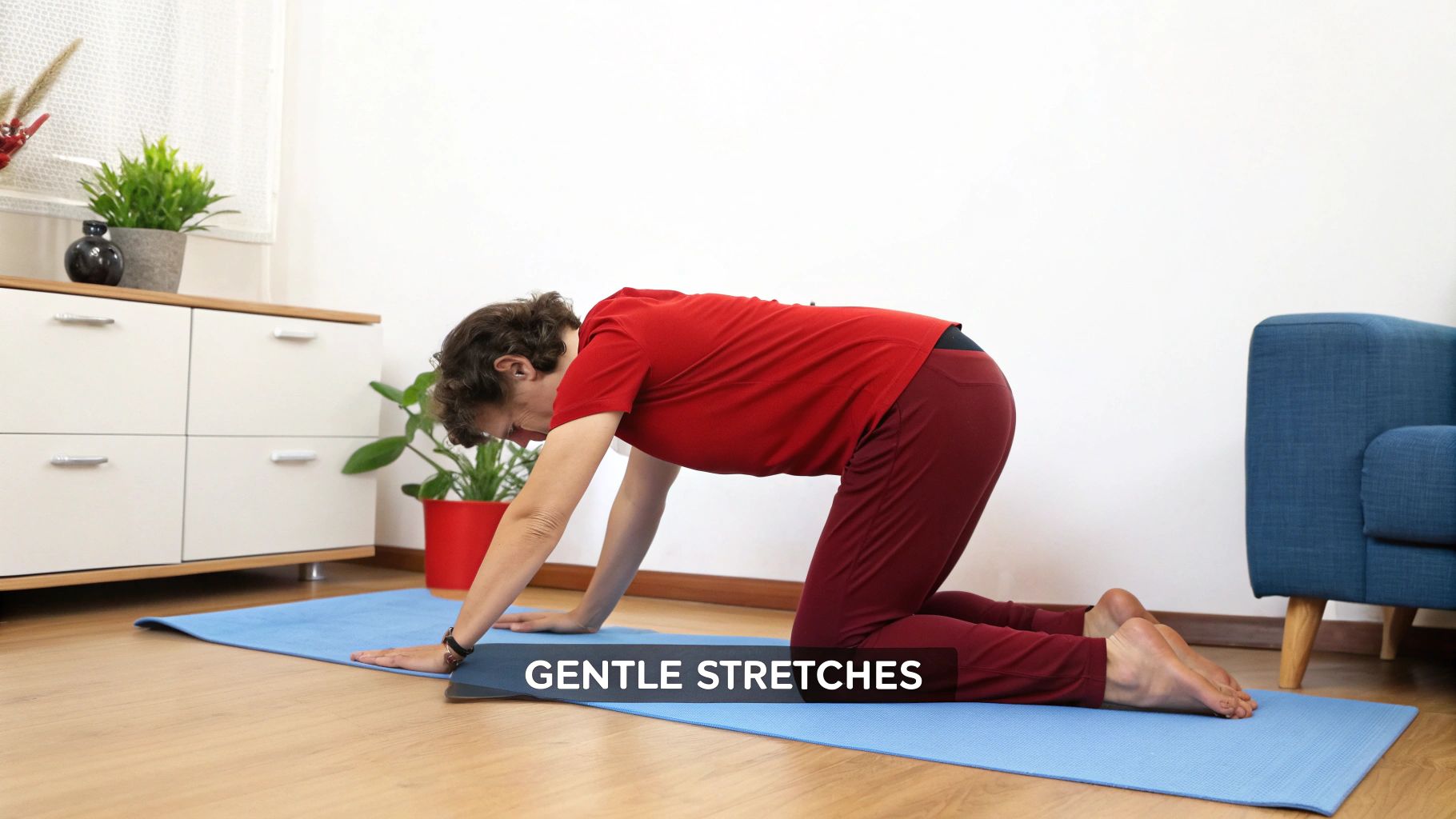
The good news is that making minor, mindful adjustments to these habits can dramatically reduce the stress on your lumbar spine. This is all about working smarter, not harder, to create an environment where your back feels supported instead of constantly under strain.
Creating a Spine-Friendly Workspace in Green Bay
It doesn’t matter if you work in a corporate office in Green Bay or from a spare bedroom at home—your desk setup is a huge player in your spinal health. Hours spent hunched over a laptop is one of the most common triggers for lower back pain. The goal is simple: create a neutral spine position where your body is relaxed and aligned.
Poor posture is a massive factor, contributing to a large percentage of back pain cases. Simple ergonomic fixes can make a world of difference. According to OSHA guidelines, maintaining a neutral spine while you work can slash your risk of strain by as much as half. You can learn more about these posture findings to see just how much small changes matter.
Here’s how to set up your station for success:
- Chair Height: Adjust your chair so your feet are flat on the floor. Your knees should be level with or just slightly below your hips. If your feet are dangling, use a footrest.
- Lumbar Support: Your chair should have lower back support that fits the natural curve of your spine. If it doesn’t, a rolled-up towel or a small lumbar pillow works wonders to fill that gap.
- Monitor Position: Place your monitor about an arm’s length away, with the top of the screen at or just below eye level. This stops you from craning your neck forward.
- Keyboard and Mouse: Keep your keyboard and mouse close enough that your elbows can stay comfortably by your sides, bent at a relaxed 90-degree angle.
Pro Tip: Set a timer. Get up and move around for a few minutes every hour. A quick walk to grab water or a few simple stretches is all it takes to reset your posture and keep stiffness from setting in.
Beyond the Desk: Daily Movements That Matter
Your workspace isn’t the only trouble spot. Seemingly harmless daily activities can put a ton of strain on your back if you’re not careful.
A long commute, for instance, can be just as taxing as a day at your desk. Make sure your car seat is adjusted so you’re sitting upright, with your knees slightly higher than your hips. If your car lacks good support, use that same lumbar pillow. Try to avoid slouching over the steering wheel.
Even your shoes have an impact. High heels throw your posture out of alignment, forcing an unnatural arch in your lower back. Whenever possible, opt for supportive shoes with good cushioning, especially on days when you know you’ll be on your feet a lot.
The Art of Lifting Safely
Improper lifting is one of the fastest ways to trigger an acute lower back injury. And it’s not just about heavy boxes at work. Lifting groceries, a toddler, or even a laundry basket the wrong way can lead to a painful muscle strain.
Follow these simple rules to protect your spine:
- Keep a Wide Stance: Plant your feet shoulder-width apart to create a stable base.
- Bend at Your Knees and Hips: Never bend over from your waist. Always squat down, keeping your back straight and your chest up.
- Use Your Leg Muscles: Let your powerful leg and glute muscles do the heavy lifting, not your delicate back.
- Hold the Object Close: Keeping the load as close to your body as possible dramatically reduces the strain on your spine.
- Avoid Twisting: To turn, move your feet. Don’t twist your torso while holding a load.
These small, conscious changes really add up. By improving your daily ergonomics and movement patterns, you actively reduce the wear and tear on your spine—a crucial step to relieve lower back pain naturally for good. If you’re struggling to pinpoint what’s causing your pain, a consultation with a chiropractor in Green Bay, WI can provide a professional assessment of your biomechanics.
The Overlooked Connection Between Sleep, Nutrition, and Back Pain
Healing isn’t always an active process. In fact, a lot of your body’s best repair work happens while you’re fast asleep.
The food you eat and the quality of your rest are two of the most powerful—and most overlooked—tools you have for relieving lower back pain. Think of sleep as the time your body’s repair crew gets to work, and nutrition as the high-quality building materials they need to do the job right.
When either of these is lacking, your recovery can stall, leaving you stuck in a frustrating cycle of stiffness and discomfort. A few simple adjustments to how you sleep and what you eat can dramatically reduce inflammation and support your spine.
Optimizing Your Sleep for Spinal Alignment
We spend roughly a third of our lives in bed, so it’s no surprise that sleeping posture has a massive impact on back health. If you wake up feeling even stiffer than when you went to bed, your sleeping position or mattress is likely part of the problem.
The goal is to maintain a neutral spine, where your ears, shoulders, and hips stay in a relatively straight line.
Here’s how to achieve that in the two best positions:
- On Your Back: This is often considered the best position. To make it even better, place a small pillow under your knees. This simple trick helps flatten your lower back just enough to take pressure off the spine, letting your muscles relax.
- On Your Side: If you’re a side sleeper, pull your legs up slightly toward your chest and stick a firm pillow between your knees. This is crucial—it stops your top leg from sliding forward and twisting your lower back out of alignment all night long.
The absolute worst position for your back is sleeping on your stomach. It forces an unnatural arch in your lower back and makes you twist your neck for hours, creating strain all the way from your tailbone to your skull.
Your mattress matters, too. One that’s too soft will let your hips sink out of alignment, while one that’s too firm won’t cushion your body’s natural curves. For most people, a medium-firm mattress is the sweet spot for supporting the back without creating painful pressure points.
Fueling Your Body to Fight Inflammation
The food you eat can either fuel inflammation or fight it. For many people, chronic, low-grade inflammation is a major driver of persistent back pain. Shifting your diet toward anti-inflammatory foods helps calm your system from the inside out.
Try to work these nutritional powerhouses into your meals:
- Leafy Greens: Spinach and kale are packed with antioxidants.
- Fatty Fish: Salmon and mackerel are loaded with omega-3 fatty acids, which are proven to reduce inflammatory compounds.
- Berries and Cherries: These fruits contain powerful anti-inflammatory effects.
- Nuts and Seeds: Almonds, walnuts, and chia seeds deliver healthy fats and more inflammation-fighting power.
- Spices: Turmeric contains curcumin, a powerful anti-inflammatory compound. It’s easy to add to soups, smoothies, or scrambled eggs.
And don’t forget to stay hydrated. Your spinal discs—the soft shock absorbers between your vertebrae—are made of a gel-like substance that is mostly water. When you’re dehydrated, these discs can lose height, which puts more stress on your spine. Aim to drink plenty of water all day to keep them healthy.
Making these lifestyle changes is a cornerstone of our approach to long-term wellness care because they empower your body’s natural ability to heal itself. If pain continues despite these efforts, a professional assessment can help identify any underlying structural issues.
When to Consider Professional Chiropractic Care in Green Bay
You’ve done the right things. You’ve been diligent with stretches, used ice and heat, and made a real effort to improve your daily habits. But if that nagging lower back pain is still hanging around, it’s a clear signal that it’s time to call in an expert.
Trying to “wait it out” when pain isn’t improving can sometimes allow a simple problem to become a chronic one.

Often, the underlying cause is more than just muscle tightness. It could be a misaligned vertebra, a bulging disc, or nerve irritation that simply won’t resolve on its own. A chiropractor in Green Bay, WI can perform a thorough assessment to pinpoint the real source of your discomfort and create a plan to get you lasting relief.
Key Signs It’s Time to See a Chiropractor
It’s easy to think, “I’ll just give it another week.” But some symptoms are your body’s way of telling you that something more serious is going on.
Pay close attention to these signs:
- Pain Radiating Down Your Leg: If your lower back pain comes with shooting pain, numbness, tingling, or weakness that travels into your glute or down your leg, that’s a classic sign of sciatica or nerve compression.
- Pain That Doesn’t Improve With Rest: When the pain is constant and a day or two of taking it easy doesn’t help, it suggests the issue isn’t just a simple muscle strain.
- Pain After a Specific Injury: Back pain that starts right after a fall, car accident, or lifting injury should always be professionally evaluated to rule out any significant damage.
- Difficulty Performing Daily Activities: When your back pain starts interfering with your ability to work, sleep, or enjoy your hobbies, it’s time to get help.
If any of these sound familiar, putting off a consultation could mean a much longer recovery. You can learn more about how we help by reading our guide on chiropractic care for back pain in Green Bay, WI.
How Chiropractic Adjustments Restore Function
The core of chiropractic care is the spinal adjustment. This isn’t about “cracking” your back; it’s a specific and gentle technique used to correct misalignments in the spine, which we call subluxations. These misalignments can disrupt nerve signals and put uneven stress on your spinal discs and joints, causing pain and stiffness.
By applying a precise, controlled force to a specific joint, a chiropractor helps restore proper motion and takes pressure off irritated nerves. This doesn’t just relieve pain—it improves your body’s overall function by allowing your nervous system to communicate more effectively.
What This Means for You: A properly aligned spine moves better, feels better, and is more resilient to daily stress. Chiropractic adjustments help your body heal itself by addressing the structural cause of the problem, not just masking the symptoms.
Advanced Non-Surgical Treatments for Deeper Relief
For some conditions, traditional adjustments are just one piece of the puzzle. Modern chiropractic clinics offer advanced, non-surgical therapies designed to address more complex issues like herniated discs and chronic tissue damage.
These treatments provide targeted relief that goes beyond what manual adjustments alone can achieve. They are particularly effective for patients who haven’t found success with other conservative methods and are looking for a real alternative to injections or surgery.
Exploring Your Options for Complex Back Pain
Here are two highly effective therapies we use to help patients in Green Bay get their lives back:
- Non-Surgical Spinal Decompression: This therapy is a game-changer for people suffering from bulging or herniated discs and sciatica. You lie on a specialized table that gently and precisely stretches your spine. This creates a negative pressure inside the discs, which can help retract the bulging material away from the nerve and pull in healing nutrients. It’s a safe and comfortable way to relieve nerve compression at its source.
- SoftWave Therapy: This innovative treatment uses unfocused shockwaves to stimulate your body’s own natural healing and regeneration processes at the cellular level. It helps decrease inflammation, improve blood flow, and activate stem cells to repair damaged soft tissues like muscles, ligaments, and tendons. For chronic lower back pain caused by old injuries or degenerative changes, SoftWave can kickstart a healing response that has been dormant for years.
These advanced options, combined with chiropractic adjustments, create a powerful approach to relieve lower back pain naturally. By addressing both spinal alignment and tissue health, we can build a comprehensive plan that finally gets to the root of your pain.
Common Questions About Natural Back Pain Relief
Even with the best plan, questions always come up. To help you feel more confident, here are some straightforward answers to the questions we hear most often from our patients here in Green Bay.
How Long Should I Try Home Remedies Before Seeing a Chiropractor?
Starting with self-care is smart, but knowing when to call a professional is just as important.
As a general rule, if you’ve been consistent with gentle stretches, heat or ice therapy, and modifying your activities for 1-2 weeks without any real improvement, that’s your cue to get a professional evaluation.
Some symptoms, however, are more urgent. If your pain is severe, shoots down your leg, or is accompanied by numbness or weakness, you should schedule an appointment with a chiropractor in Green Bay, WI, right away. Getting ahead of the problem early is the best way to prevent it from becoming a chronic issue.
Are Chiropractic Adjustments a Safe Option for My Lower Back?
Yes, absolutely. When performed by a licensed and experienced Doctor of Chiropractic, spinal adjustments are an incredibly safe and effective treatment for the most common causes of lower back pain. Your safety is our top priority.
Here at our Green Bay clinic, we start with a thorough examination and a detailed health history before any treatment begins. This ensures you’re a good candidate for care and allows us to tailor every adjustment specifically to your body and your condition. The techniques are precise and gentle, designed to restore healthy movement and fix the underlying structural issue causing your pain.
Can I Still Exercise if My Lower Back Hurts?
Yes, and in most cases, you absolutely should. The key is to choose the right kind of movement. Lying on the couch for days can actually make stiffness and pain worse.
Gentle, low-impact activities are your best friend. Think about things like:
- Walking: This is fantastic for increasing blood flow to your spinal muscles without putting jarring stress on your joints.
- Swimming or Water Aerobics: The buoyancy of water supports your body, creating an almost weightless environment for pain-free movement.
- Targeted Core Exercises: Moves like the bird-dog or glute bridges (which we covered earlier) are perfect for building the muscular support system your spine needs.
What should you avoid? High-impact activities like running, jumping, or heavy lifting that could aggravate the area. The golden rule is simple: listen to your body. If any movement causes sharp or worsening pain, stop immediately.
Key Insight: Movement is often medicine for back pain. It’s not about pushing through the pain, but about finding gentle ways to keep your spine mobile and your support muscles engaged.
What Makes Non-Surgical Spinal Decompression Different From Stretching?
This is a fantastic question. While both can feel good, they work in completely different ways.
Regular stretching is great for improving general muscle flexibility and easing overall tension. It’s an important piece of the puzzle.
Non-surgical spinal decompression, however, is a highly specific and targeted therapy. It uses a computer-controlled table to apply a precise and gentle pulling force to the spine. This process creates negative pressure inside your spinal discs—almost like a vacuum effect.
This gentle vacuum can help draw bulging or herniated disc material back into place, taking pressure off pinched nerves. It also helps pull vital oxygen, water, and nutrients into the discs, which is critical for promoting healing. It’s a therapy that can provide a level of relief for conditions like sciatica or disc disease that simple stretching just can’t match.
At Cornerstone Chiropractic, we’re focused on finding the root cause of your pain and giving you a clear path to lasting relief. If you’re tired of temporary fixes and ready to feel better for good, we invite you to schedule a consultation at our Green Bay office. Learn more and book your visit today at https://drbillbinsfeld.com.