Your Guide to Whiplash Injury Recovery Time in Green Bay
After a car accident in Green Bay, the first question on many people’s minds is, “How long will it take to feel normal again?” If you’re dealing with neck pain, stiffness, or headaches from a recent auto accident, we want you to know that recovery is possible. While every whiplash injury is different, the good news is that most people see significant improvement within a few weeks to several months. As a trusted chiropractor serving the Green Bay community, our goal is to provide a clear, honest look at the typical whiplash injury recovery time so you know what to expect on the road ahead.
Understanding the Typical Whiplash Recovery Timeline
When you’re dealing with the neck pain, stiffness, and headaches that follow an auto accident, the uncertainty can be one of the biggest sources of stress. Here at Cornerstone Chiropractic, we understand. We know the pain and confusion you’re feeling, and our first job is to bring clarity and a path forward, starting with a realistic look at what the healing process really involves.
Recovery from whiplash isn’t a simple, straight line; it’s a journey influenced by the severity of the crash, your overall health, and—most importantly—how quickly you seek proper care from a local auto injury chiropractor. For most people, this journey has distinct phases of healing, from the initial acute pain to the long-term restoration of function. Just understanding these general milestones can help you feel more in control of your health again.
Healing Milestones You Can Expect
Research gives us some helpful benchmarks for whiplash injury recovery time. For more minor injuries, a lot of patients heal relatively quickly. In fact, studies show that approximately 75% of patients recover within the first two to three months.
However, for those with more significant injuries from a car accident, the timeline naturally extends. Around 50% of these patients will have recovered by the end of the first year. Another 25% find their healing continues between 12 and 18 months after the initial injury. It’s worth noting that the average treatment duration seen across multiple studies was about 29 weeks. You can explore more on these whiplash recovery statistics to get a fuller picture of the healing process.
This timeline helps visualize these key recovery milestones for our patients here in Green Bay, WI.
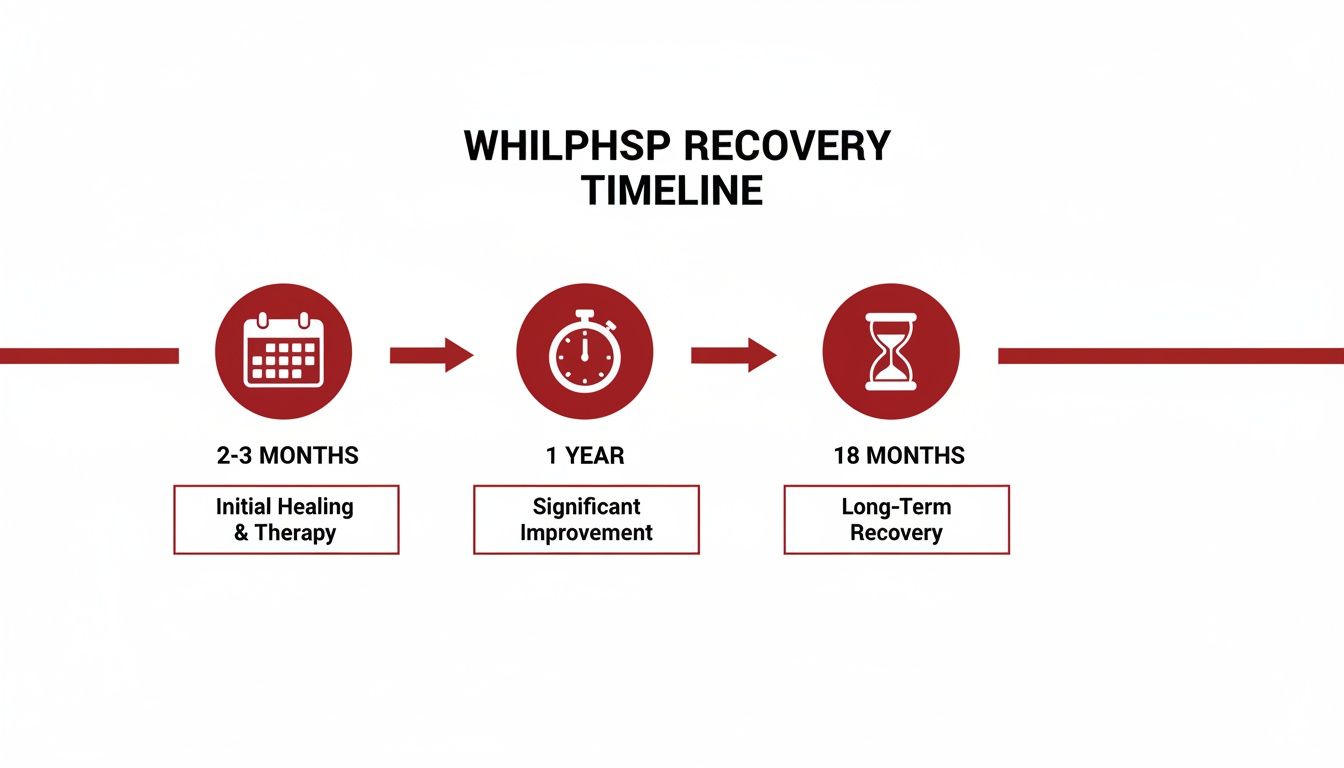
As you can see, while many find relief in the short term, a significant number of people need dedicated care for a year or even longer to truly achieve a full recovery.
To make this easier to understand, here’s a simple breakdown of what to expect during each phase of healing.
Typical Whiplash Recovery Phases at a Glance
This table provides a simplified overview of the typical stages of whiplash recovery, from the initial acute phase to long-term healing, to help patients in Green Bay understand their journey.
| Recovery Phase | Typical Duration | Common Symptoms | Primary Goal |
|---|---|---|---|
| Acute Phase | First 2-4 Weeks | Sharp neck pain, stiffness, headaches, muscle spasms | Manage pain and inflammation, protect the injured area |
| Subacute Phase | 4-12 Weeks | Aching and stiffness, reduced range of motion, lingering pain | Restore mobility, begin gentle exercises, promote tissue healing |
| Remodeling Phase | 3-6 Months | Decreased pain, occasional flare-ups with activity | Strengthen supporting muscles, improve endurance, normalize function |
| Chronic Phase | 6+ Months | Persistent stiffness or pain, especially if not treated properly | Manage ongoing symptoms, prevent long-term dysfunction |
This table shows why addressing the injury early is so crucial. The goals in the early phases are all about setting the stage for a complete and successful long-term recovery.
Why Proactive Care is Essential
One of the most critical takeaways here is that “waiting it out” is often the worst strategy you can adopt. Lingering inflammation and spinal misalignments from the accident can pave the way for chronic pain, persistent headaches, and mobility issues that stick around for years. Seeking a proper diagnosis from an auto injury chiropractor near you is the single best first step toward preventing acute pain from settling in for the long haul.
At Cornerstone Chiropractic, Dr. Bill Binsfeld focuses on getting to the root cause of your whiplash symptoms. By gently restoring proper alignment to your cervical spine, we can:
- Alleviate pressure on irritated nerves.
- Reduce inflammation in damaged soft tissues.
- Improve your neck’s range of motion.
- Decrease the intensity and frequency of headaches.
Our patient-focused approach right here in Green Bay ensures you get a personalized treatment plan designed to support your body’s natural healing power and shorten your recovery time.
Understanding What Happens to Your Neck During Whiplash
To really get a handle on whiplash recovery time, you first have to understand what the injury actually is. Many people in Green Bay hear the term, but they don’t quite realize the level of damage it can cause. The name “whiplash” is brutally accurate—it describes the violent, whip-like snap of your head, first forward and then backward, that happens most often in a rear-end car accident.

This isn’t just a minor strain. We’re talking about an intense acceleration-deceleration force that shoves the delicate structures of your neck far beyond their breaking point. Your cervical spine is built for an incredible range of motion, but it was never designed to handle that kind of sudden, violent impact.
The Cascade of Damage Inside Your Neck
When your head snaps back and forth like that, a whole sequence of injuries can happen in the blink of an eye. The first things to give way are usually the soft tissues—the muscles, ligaments, and tendons that support your head and keep your movements smooth.
Think of a rubber band being stretched way too far, way too fast. It can fray with tiny tears or even snap altogether. That’s a perfect picture of what happens to the ligaments and muscles in your neck during a whiplash event. This micro-tearing is what kicks off the body’s inflammatory response, leading to the pain, swelling, and severe stiffness so many auto injury patients know all too well.
From Torn Tissues to Widespread Symptoms
But the damage doesn’t stop with the soft tissues. The same forces that tear up muscles can also injure the more critical structures of your spine. For many patients, the symptoms they feel are a direct result of this deeper, more serious damage.
Here’s a breakdown of what can happen inside your cervical spine:
- Spinal Misalignments: The vertebrae in your neck can get knocked out of their proper alignment, creating what we as chiropractors call a subluxation. This throws off normal joint mechanics and can seriously irritate the nerves nearby.
- Disc Injuries: The soft, gel-like discs that cushion your vertebrae can bulge, herniate, or tear under the force. A damaged disc can press on your spinal cord or nerve roots, shooting pain down into your shoulders, arms, or hands.
- Nerve Irritation: Swelling from torn tissues and pressure from misaligned vertebrae can “pinch” or inflame the sensitive nerves exiting your spinal column. This nerve interference is often the real culprit behind headaches, dizziness, and that foggy-headed feeling.
This domino effect of damage is why whiplash symptoms can be so varied and, frankly, confusing. What starts as a simple neck injury can quickly spiral into issues that affect your entire body and even your ability to think clearly. For a deeper dive, you can learn more about the specifics of whiplash injuries and their symptoms in our detailed guide.
The connection between the initial injury and long-term symptoms is critical. Without proper treatment to address the root causes—like spinal misalignments and tissue damage—the body may not heal correctly, leading to chronic issues.
This is exactly why some people struggle for years after an accident. One study found that 64% of whiplash patients had the same level of symptom severity at 7.5 years as they did just three months after their injury. This tells us that the first few months are a critical window for healing and that symptoms often just stabilize without actually resolving on their own.
At Cornerstone Chiropractic in Green Bay, our entire focus is on intervening during this vital period. We work to promote true healing and stop chronic pain from ever taking root.
Key Factors That Influence Your Recovery Timeline
Have you ever wondered why one person seems to bounce back from whiplash in six weeks, while someone else is still struggling six months later? It’s a question we hear all the time in our Green Bay clinic. The truth is, just like every patient is unique, every healing journey is personal.
Your path to recovery is shaped by several key factors that can either speed things up or slow them down. Understanding these variables is powerful because it allows you to take an active role in your own healing. While some things, like your age, are out of your control, others—especially how quickly you seek care—can make a world of difference in your outcome.
Severity of the Accident and Tissue Damage
The most straightforward factor is the intensity of the accident itself. It just makes sense: a low-speed fender bender at a Green Bay intersection will likely cause far less tissue damage than a high-speed collision on the highway.
More severe impacts can lead to extensive tearing of muscles and ligaments, damage to the vertebral discs, and significant spinal misalignments. The greater that initial damage, the more time your body needs to repair and remodel all those delicate tissues. This is exactly why a thorough initial exam is so critical—it helps us set realistic expectations from day one.
Age and Overall Health Status
Your body’s baseline health plays a huge role in its ability to bounce back from trauma. Younger individuals often heal more quickly, and that’s largely because their cellular repair mechanisms are simply more robust and efficient.
But it’s not just about age. Your general health is a major contributor. Conditions that affect your circulation or immune response can put the brakes on the healing process. On the flip side, patients who are generally healthy, active, and non-smokers tend to give their bodies a much better foundation for a faster, more complete recovery.
The single most important controllable factor in your recovery is how quickly you seek professional care. Addressing the injury promptly helps control inflammation, prevent the formation of improper scar tissue, and stop acute pain from becoming a chronic, long-term problem.
Pre-Existing Spinal Conditions
Many people have underlying spinal conditions they don’t even know about until an injury shines a spotlight on them. Things like degenerative disc disease, spinal stenosis, or arthritis in the neck can make the cervical spine more vulnerable to injury.
An auto accident can then act like gasoline on a smoldering fire, aggravating these pre-existing issues. This often complicates the injury and extends the recovery period. Part of our diagnostic process at Cornerstone Chiropractic involves identifying any of these underlying factors that could impact your personalized treatment plan. Our goal is to address not just the new injury, but also to support your overall spinal health. You can learn more about how chiropractic care helps auto accident patients in Green Bay navigate these exact complexities.
How Different Factors Impact Whiplash Healing
To make it clearer, let’s break down how these variables can push your recovery in one direction or the other. This table compares how certain factors can either speed up or delay the whiplash healing process, helping you see which areas you have some control over.
| Influencing Factor | Potential Positive Impact (Faster Recovery) | Potential Negative Impact (Slower Recovery) |
|---|---|---|
| Promptness of Care | Seeking immediate care reduces inflammation and prevents chronic patterns. | Waiting allows scar tissue to form incorrectly and pain to become chronic. |
| Accident Severity | Low-impact collision with minimal forces on the neck. | High-speed impact causing extensive soft tissue and joint damage. |
| Overall Health | Being active, a non-smoker, and having good circulation. | Having conditions that impair healing, such as diabetes or a sedentary lifestyle. |
| Pre-existing Issues | A healthy, well-aligned cervical spine prior to the accident. | Pre-existing arthritis, disc degeneration, or previous neck injuries. |
| Treatment Adherence | Consistently following your personalized chiropractic care plan and home advice. | Missing appointments or failing to perform recommended exercises and stretches. |
Ultimately, taking a proactive approach is your best strategy. By seeking a proper diagnosis from an auto injury chiropractor right away, you give your body the best possible chance to heal correctly and efficiently. This is key to minimizing your whiplash injury recovery time and getting you back to your life here in Green Bay.
How Chiropractic Care Speeds Up Whiplash Recovery
When you’re dealing with a whiplash injury in Green Bay, the goal is simple: heal correctly, heal quickly, and get back to your life without lingering problems. Pain medication might offer a temporary break, but it does absolutely nothing to fix the structural damage underneath. At Cornerstone Chiropractic, Dr. Bill Binsfeld goes straight to the source, using a hands-on approach to kickstart your body’s own healing powers.
Our philosophy is straightforward—restore proper function to the spine, and the body can take care of the rest. Whiplash violently knocks your neck’s alignment out of whack and damages the muscles and ligaments holding everything together. Chiropractic care is designed to address those core issues, creating a solid foundation for real, lasting recovery.

Restoring Spinal Alignment with Gentle Adjustments
The cornerstone of our care is the spinal adjustment. During that sudden jolt of a whiplash event, the vertebrae in your neck get forced out of their natural position, creating what we call subluxations. These misalignments set off a chain reaction of problems.
They lock up your neck, trigger intense muscle spasms, and put direct pressure on the delicate nerves branching out from your spinal cord. This nerve irritation is what drives so many whiplash symptoms, from the sharp pain in your neck to the numbness in your arms and those relentless headaches.
Dr. Binsfeld uses precise and gentle chiropractic adjustments to carefully restore movement and proper alignment to these stuck joints. This process tackles several critical goals at once:
- It relieves nerve pressure, often bringing immediate relief and improving the vital communication lines between your brain and body.
- It restores mobility, which tells all those tight, guarded muscles that it’s safe to finally relax.
- It reduces inflammation by getting the joints moving correctly again and improving circulation to the injured tissues.
By fixing the underlying structural problem, adjustments help your body move out of the initial crisis mode and into the all-important repair phase. If you want to dive deeper into how chiropractic helps with all sorts of neck issues, you can learn more about how to relieve neck pain with our detailed guide.
Advanced Healing with SoftWave Therapy
To give your body’s repair process an extra boost, Cornerstone Chiropractic offers SoftWave Therapy, a game-changing treatment for soft tissue injuries just like the ones from whiplash. This non-invasive technology uses powerful acoustic waves to reach damaged tissues deep under the skin.
Think of it as sending a wake-up call to your body’s own internal repair crew. These waves trigger your natural healing mechanisms right at the cellular level.
SoftWave Therapy actually signals your body’s own stem cells to migrate to the injury site. This process helps form new blood vessels (angiogenesis) and calms inflammation, leading to faster and more complete tissue regeneration.
For our whiplash patients here in Green Bay, this means we can directly treat the torn muscles and ligaments that an adjustment alone can’t fix. It’s fantastic for breaking down stubborn scar tissue and rebuilding the area with healthier, stronger tissue.
Alleviating Disc Pressure with Spinal Decompression
In more severe whiplash cases, the impact can be strong enough to damage the discs that cushion your vertebrae, causing them to bulge or even herniate. When a disc is damaged, it can press on your spinal cord or nerves, causing debilitating pain, numbness, or tingling that shoots down your arms.
For these specific injuries, Dr. Binsfeld may recommend non-surgical spinal decompression. This is a gentle, computer-controlled therapy that works by slowly and methodically stretching the spine.
This stretching creates a negative pressure inside the disc—almost like a vacuum. This can help suck the bulging material back into place, pulling it off the irritated nerve. At the same time, it draws a fresh supply of oxygen, water, and nutrients into the disc to help it heal from the inside out.
Our integrated approach makes sure we address every single component of your whiplash injury. By combining precise chiropractic adjustments with advanced tools like SoftWave and spinal decompression, we create the ideal healing environment to not only get you out of pain but also restore your function and significantly shorten your whiplash injury recovery time.
What to Expect at Your Whiplash Consultation in Green Bay
Taking that first step after a car accident can feel overwhelming. At Cornerstone Chiropractic, we get it. That’s why we’ve designed our entire process to be clear, comfortable, and reassuring from the moment you call our Green Bay office. Knowing what to expect can make all the difference, so let’s walk through exactly what your first visit for whiplash care looks like with us.

We see your visit as a partnership. Our patient-focused process is built around you, making sure you feel heard and confident from day one. Our goal isn’t just to treat you; it’s to give you clarity and a solid plan for getting better.
Your First Call and Initial Welcome
Your journey back to health starts with a simple phone call to our clinic at (920) 434-6333. Our friendly team will listen to your concerns, answer your questions, and find a convenient time for you to come in. We proudly offer same-day appointments for auto injury patients because we know that getting help quickly is a major factor in a faster whiplash injury recovery time.
When you arrive at our office, located at 2765 S Oneida St in Green Bay, WI, you’ll be greeted with a warm welcome. We’ll help you with any paperwork and can even assist with verifying your insurance benefits to make the whole process as smooth and stress-free as possible.
A Comprehensive Consultation and Examination
This is where we really dig in to figure out what’s going on. You’ll sit down one-on-one with Dr. Bill Binsfeld to discuss the details of the accident and the specific symptoms you’re experiencing. This conversation is your time to share your story and what you hope to achieve with your care.
After that, Dr. Binsfeld will perform a thorough physical and neurological examination. This hands-on assessment is designed to pinpoint the exact source of your pain and may include:
- Range of motion tests to see how well your neck is moving and identify any stiffness or restrictions.
- Palpation to feel for muscle spasms, inflammation, and joint misalignments in your neck and upper back.
- Orthopedic and neurological tests to check your reflexes, muscle strength, and nerve function, which helps rule out more serious injuries.
This detailed evaluation lets us get an accurate diagnosis of your whiplash injury and understand precisely how it’s affecting your body.
We believe in total transparency. Dr. Binsfeld will explain his findings in plain English, connecting the dots between your symptoms—whether it’s neck pain, headaches, or dizziness—and the underlying structural issues caused by the accident.
Creating Your Personalized Treatment Plan
Based on the exam, we’ll develop a personalized treatment plan that’s tailored to your specific needs and recovery goals. This isn’t some cookie-cutter solution; it’s a strategic roadmap designed to get you back to feeling like yourself as efficiently and safely as possible.
We will clearly outline the recommended therapies, which might include gentle chiropractic adjustments, SoftWave Therapy for deep tissue repair, or spinal decompression for any disc-related pain. We’ll also discuss how often you’ll need to come in and give you a realistic timeline for your recovery.
Our commitment is to empower you with knowledge and a clear path forward. By the time you leave your first visit, you will have a complete understanding of your injury, your treatment plan, and the next steps on your healing journey right here in Green Bay.
Your Questions About Whiplash Recovery Answered
Navigating the aftermath of a car accident is confusing. You’re dealing with insurance, car repairs, and a body that just doesn’t feel right. It’s only natural to have a lot of questions.
Here in our Green Bay clinic, we hear the same concerns from auto injury patients every day. Below, we’ve answered some of the most common questions head-on to give you the clarity you need to move forward with confidence.
Should I See a Chiropractor Even for a Minor Fender Bender?
Yes, absolutely. This is probably the single most important piece of advice we can give. One of the biggest mistakes people make after a collision is thinking, “It was just a small bump, I feel fine.”
Here’s the problem with that logic: adrenaline is a powerful painkiller. It can completely mask the signs of an injury for hours, or even days. Meanwhile, the force from even a 5 mph impact is enough to knock vertebrae out of alignment and create micro-tears in the delicate muscles and ligaments of your neck.
Getting a prompt evaluation from an auto injury chiropractor in Green Bay is the only way to know for sure what’s going on beneath the surface. Catching these issues early is the key to preventing them from snowballing into chronic neck pain, stiffness, and headaches down the road.
How Do I Know Chiropractic Adjustments Are Safe for Whiplash?
That’s an excellent and fair question. The idea of having your neck adjusted after it’s been injured can sound intimidating, but it’s crucial to understand that chiropractic care for whiplash is completely different from a standard adjustment.
There is no forceful twisting or aggressive “popping.” Dr. Binsfeld uses specific, gentle techniques tailored for acute injuries. Think of it as nudging, not forcing. These are precise, low-force movements designed to gently restore motion to spinal joints that have become locked up and relieve pressure on irritated nerves. We do this without ever aggravating the already-injured soft tissues. Your safety and comfort are always the top priority.
What Can I Do at Home to Help My Recovery?
Your active participation makes a huge difference in speeding up your whiplash injury recovery time. While your in-office treatments are the foundation of your recovery, the work you do at home helps support that progress. Dr. Binsfeld will always give you a personalized self-care plan.
This typically includes simple but effective strategies like:
- Proper Ice Application: In the early stages, using an ice pack for 15-20 minutes at a time is one of the best ways to calm inflammation and take the edge off sharp pain.
- Gentle Stretching: Once the initial inflammation has subsided and Dr. Binsfeld gives you the green light, specific range-of-motion exercises are key. They prevent stiffness and stop scar tissue from permanently limiting your mobility.
- Postural Awareness: We’ll show you how to sit, stand, and even sleep in a way that supports your neck’s natural curve. This prevents you from accidentally putting extra strain on tissues that are working hard to heal.
Remember, the goal of at-home care is to support the healing process, not to push through the pain. Always follow the specific guidance you receive during your consultation at our Green Bay office. This ensures you’re helping, not hindering, your recovery.
When Should I Be Worried About My Symptoms?
Most whiplash symptoms will steadily improve with the right care, but there are a few red flags that signal something more serious might be going on.
If you experience any of the following, it’s important to seek an evaluation right away:
- A headache that gets dramatically worse and doesn’t respond to care.
- Severe dizziness, confusion, or a feeling of “brain fog.”
- Numbness, tingling, or weakness that spreads down your arms or into your legs.
- Trouble with your balance or walking normally.
These symptoms could point to a more significant injury that needs immediate attention. Our thorough examination process at Cornerstone Chiropractic is designed to identify these signs early on, making sure you get exactly the right kind of care you need, right when you need it.
Don’t let unanswered questions keep you from getting the relief you deserve. The team at Cornerstone Chiropractic is here to provide the answers and the care you need to navigate your recovery with confidence. Schedule your consultation today to start your journey back to feeling your best.