Sciatica Chiropractor in Green Bay: Your Guide to a Pain-Free Night’s Sleep
If that sharp, radiating leg pain from sciatica is turning your nights into a nightmare, you know how desperate the search for a comfortable position can feel. Just when you need rest the most, a compressed sciatic nerve sends shooting pains down your leg, making any position feel impossible. As a trusted chiropractor in Green Bay, we help patients struggling with this exact problem every day.
The good news? There are immediate strategies you can try tonight. The quickest fix is often to sleep on your side with a pillow wedged between your knees, or on your back with a pillow tucked under your knees. This simple trick helps maintain your spinal alignment and can instantly reduce that painful nerve pressure.
Your Guide to a Pain-Free Night with Sciatica
The intense, burning, or jolting pain of sciatica can make bedtime something you dread. When you finally lie down, the pressure on your spinal discs can shift, which often aggravates an already irritated sciatic nerve. This can make a good night's rest feel completely out of reach.
But simple changes can offer significant relief, helping you break that frustrating cycle of pain and sleeplessness.
As a wellness partner for our Green Bay community, we at Cornerstone Chiropractic see the frustration that comes with chronic pain every single day. We work with patients who are exhausted from their struggle with how to sleep with sciatica, and we're here to provide the compassionate care and effective solutions you need to find lasting comfort. If you are looking for a sciatica chiropractor near me, our clinic is here to help.
Finding Immediate Relief Tonight
The path to better sleep starts with understanding how to properly support your body. Your main goal is to keep your spine in a neutral position—that means your ears, shoulders, and hips should all be in a straight line. This simple alignment prevents twisting or straining your lower back, which is often the source of sciatic nerve compression.
-
Pillow Placement is Everything: Using pillows strategically is one of the most powerful tools you have at home. A firm pillow between your knees when you're on your side stops your top leg from falling forward and twisting your spine. If you're on your back, a pillow under your knees helps maintain the natural curve of your lower back, taking the tension off the nerve.
-
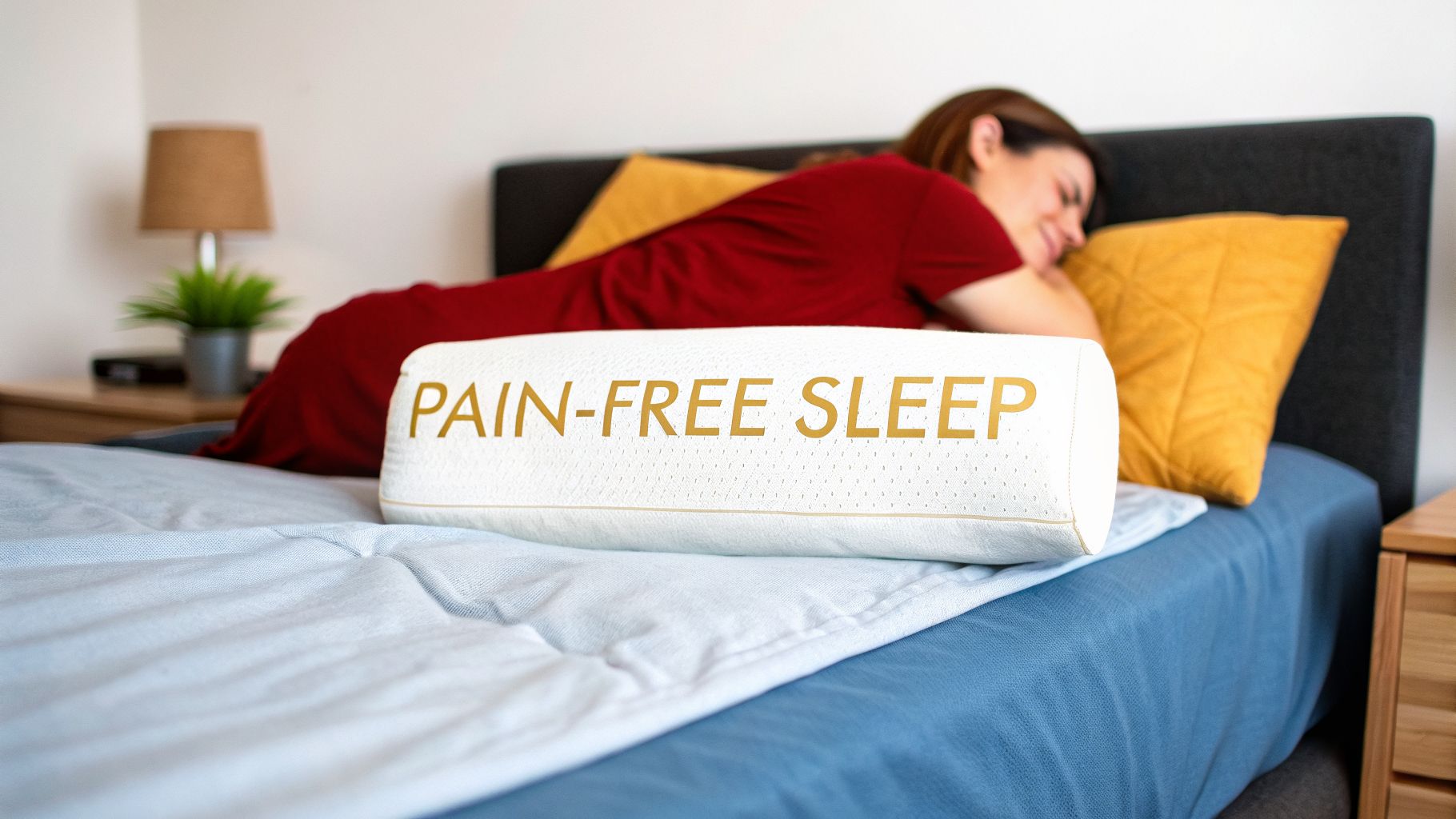
Avoid Stomach Sleeping at All Costs: This position is a recipe for disaster with sciatica. It flattens the natural curve of your spine and forces you to turn your head to one side, which can strain both your neck and back, making the pain significantly worse.
Sciatica is more than just a pain in the leg; it's a symptom of an underlying issue, like a herniated disc, spinal stenosis, or a misaligned vertebra. To get long-term relief, you have to address the root cause.
To get a better handle on your nighttime pain, a solid foundation in understanding sciatica and back pain is a great place to start. This knowledge empowers you to make smarter decisions about your own care.
At Cornerstone Chiropractic, we don’t believe in temporary fixes. We are committed to diagnosing the specific reason for your sciatica. For many in the Green Bay community, relief comes from gentle chiropractic adjustments that restore proper spinal alignment. You can learn more about how our back pain chiropractor pinpoints the source of sciatica by exploring our detailed guide on the condition: https://drbillbinsfeld.com/conditions/spine-related/sciatica/
This is just the beginning. Our full guide will walk you through everything you need to reclaim your sleep—and your life.
If you've ever found yourself wide awake at 2 AM, wondering why your sciatica decided to throw a party the second your head hit the pillow, you're not alone. It’s a frustratingly common experience. For so many people we see here in Green Bay, the pain doesn't just linger at night—it intensifies, turning what should be a time of rest into a nightly battle.
You aren’t imagining it. There are a few very real, very specific reasons why sciatica pain often gets worse at night. Once you understand what’s happening in your body, you can start to take back control and find some real relief.
The Role of Gravity and Spinal Pressure
During the day, while you’re standing and moving around, gravity is actually helping you out a bit by maintaining space between your vertebrae. But when you lie down for a long stretch, that dynamic completely flips.
Without the downward pull of gravity, the pressure inside your spine changes. This can allow the soft, jelly-like center of a herniated disc to shift or bulge just enough to press on that already sensitive sciatic nerve. This is what triggers that familiar, searing pain shooting down your leg.
Your sleeping position is a huge factor here. Lying in a way that twists your spine or flattens its natural curve can make this pressure significantly worse.
Another common culprit we see at our Green Bay clinic is piriformis syndrome. When you lie down, the muscles in your glutes—including the small piriformis muscle—begin to relax. As they do, they can shift and clamp down on the sciatic nerve that runs right underneath, causing a major flare-up.
Inflammation's Nightly Cycle
Your body runs on an internal clock that governs everything from hunger to hormone production, including inflammation. A key player in this process is cortisol, a hormone that acts as your body's natural anti-inflammatory.
Cortisol levels are highest in the morning (which is what helps you wake up and get going) and then slowly taper off throughout the day. By the time you’re ready for bed, they’re at their lowest point.
This nightly drop in cortisol means your body's built-in defense against inflammation is at its weakest. As a result, the inflammation around your sciatic nerve can surge, leading to more pain, stiffness, and discomfort right when you're trying to sleep.
This biological rhythm explains why the pain can feel so much more intense at night, even if the actual physical problem hasn't changed. You’re simply feeling the full force of the inflammation without your body’s natural dampening effect.
Sciatica is a widespread problem keeping millions from getting restful sleep. Global estimates suggest it affects 5-10% of adults. The World Health Organization also noted that low back pain, a category that frequently includes sciatica, affected a staggering 619 million people in 2020 and is projected to climb.
Despite how common it is, a 2024 study revealed a major knowledge gap: only 31.1% of people could correctly identify herniated discs as a primary cause. This lack of understanding can unfortunately delay getting the right care. You can get more details about these common misconceptions by exploring the study on public sciatica knowledge.
The Impact of Your Mattress
Finally, let’s talk about the surface you spend a third of your life on. Your mattress can either be your greatest ally or your worst enemy in the fight against sciatica.
A mattress that’s too soft will let your hips and spine sink, creating an unnatural curve. On the flip side, a mattress that’s too firm can create painful pressure points on your shoulders and hips. Both of these scenarios sabotage your spinal alignment.
An unsupportive mattress forces your lower back into a compromised position for hours on end, constantly aggravating the sciatic nerve. This is a big reason why many patients who come to see Dr. Bill Binsfeld at our Green Bay practice report that their pain is at its absolute worst the moment they wake up.
By understanding these three core triggers—changes in spinal pressure, the body's natural inflammatory cycle, and your sleep environment—you’re already one step ahead. Recognizing why the pain is happening is a powerful first step toward fixing it.
The Best Sleep Positions and Pillow Strategies
Finding the right sleeping position is one of the most powerful, immediate changes you can make to quiet down an angry sciatic nerve. When you learn how to properly support your body, you can dramatically reduce the pressure on that nerve, giving your body the chance to finally get the restorative sleep it so desperately needs.
The goal is simple: keep your spine in a neutral position. Think of it as maintaining a straight line from your ears to your shoulders and down to your hips. This alignment prevents the twisting and straining in your lower back that so often aggravates the nerve root in the first place.
The Best Position: Side Sleeping
For most people I see with sciatica, sleeping on their side is the ticket to relief. But there's a catch—just flopping onto your side isn't enough. The real magic is in the pillow placement.
Here’s how to get it right:
- Sleep on the Unaffected Side: If the pain is shooting down your right leg, try sleeping on your left side. This immediately takes direct pressure off the inflamed area.
- Bend Your Knees Gently: You don't want to pull your knees all the way up into a tight fetal position, as this can round your lower back and cause more strain. A slight, comfortable bend is perfect.
- Place a Firm Pillow Between Your Knees: This is the non-negotiable step. A good, firm pillow prevents your top leg from sliding forward and twisting your pelvis out of alignment. This one small action keeps your hips, pelvis, and spine in a perfect line.
If you notice a gap between your waist and the mattress, you can slide a small, rolled-up towel in there for a little extra support.
The Next Best Position: Back Sleeping
Sleeping on your back is another excellent way to maintain that neutral spine, as long as you make one key modification. Lying flat on your back can sometimes increase the arch in your lower back, which can lead to more tension and pain.
To fix this, simply place a pillow under your knees. This small adjustment elevates your legs just enough to relax your lower back, maintain the natural curve of your lumbar spine, and take significant pressure off the area. Just be sure your head pillow is supporting your neck without pushing your chin down to your chest.
Key Takeaway: The best positions for sciatica are side sleeping (with a pillow between your knees) or back sleeping (with a pillow under your knees). Both methods prioritize spinal alignment and relieve direct pressure on the sciatic nerve.
This cycle of poor posture leading to inflammation and pain is exactly what robs you of your sleep.

As you can see, an unsupported sleeping posture kicks off a chain reaction. It increases inflammation around the nerve, which in turn spikes your pain levels and makes restful sleep feel impossible.
The One Position to Avoid At All Costs
You might find it comfortable for a few minutes, but let me be clear: stomach sleeping is the absolute worst position for sciatica. In my experience, this position makes the problem worse in about 70-80% of cases. It flattens the natural, healthy curve of your lumbar spine and forces you to twist your neck for hours just to breathe.
This creates a cascade of misalignment all the way from your head down to your pelvis. That sustained twisting and flattening puts immense strain on your entire spine, virtually guaranteeing you'll wake up stiffer and in more pain than when you went to bed. If you're a stomach sleeper, making the switch to your side or back is one of the most critical changes you can make.
The link between sleep and pain isn’t just something patients tell us about; it's a well-documented scientific reality. Poor sleep is directly linked to worse back pain, creating a frustrating cycle where insomnia can nearly double the risk of developing low back pain. Smart positioning is your best defense. You can learn more about these sleep findings.
Pillow Selection Tips for Green Bay Residents
Choosing the right pillow is just as important as where you put it. Here are a few practical tips I give my patients here in Green Bay:
- Pillow Firmness: The pillow you place between your knees needs to be firm enough to actually keep them separated throughout the night. If it's too soft, it will compress and become useless by morning.
- Body Pillows: These can be a fantastic investment. A body pillow provides support along the entire length of your body, which is great for keeping your hips aligned and preventing you from accidentally rolling onto your stomach.
- Head Pillow Height: Your head pillow should fill the space between your neck and the mattress, keeping your head in line with your spine. Side sleepers generally need a thicker pillow than back sleepers to accomplish this.
These strategies are powerful tools you can start using tonight. Here at Cornerstone Chiropractic, we work with you to not only manage the symptoms but also get to the root cause of your sciatica. By combining these at-home adjustments with professional chiropractic care, including non-surgical options like spinal decompression, we create lasting solutions for our Green Bay community.
Build a Pre-Bed Routine to Calm Your Sciatic Nerve
That shooting pain down your leg can make bedtime feel like a battle you’re destined to lose. What you do in the hour before you try to sleep can dramatically influence how your sciatic nerve behaves all night long.
You don't need a complicated, hour-long ritual. Instead, it's about a few simple, intentional actions that signal to your body and its inflamed nerve that it's time to rest and heal. Many of our patients at Cornerstone Chiropractic find that a consistent routine becomes one of their most powerful tools for managing nighttime sciatica.

Gentle Stretches to Release Tension
When you're dealing with an irritated nerve, the goal isn't to push your flexibility to its limits. Aggressive stretching can easily backfire. The key is to gently release the tension that's built up in your lower back, hips, and glutes throughout the day. Slow, controlled movements are your best friend here.
Here are a couple of chiropractor-approved stretches that are especially effective:
-
Knee-to-Chest Stretch: Lie on your back, keeping your knees bent and feet flat on the bed. Gently bring one knee toward your chest until you feel a comfortable stretch in your lower back and glute. Hold for 20-30 seconds, then slowly release and repeat on the other side.
-
Piriformis Stretch: While on your back, cross the ankle of your painful leg over your opposite knee, creating a “figure-four” shape. Now, gently pull the bottom thigh toward you until you feel a deep stretch in the buttock. Hold this for about 30 seconds and switch.
These movements are designed to target the very muscles that often tighten up and clamp down on the sciatic nerve.
Soothing Therapies for Pain and Relaxation
Beyond stretching, a few other simple therapies can help calm both your muscles and your frazzled nervous system before you even get under the covers.
A warm bath, especially one with Epsom salts, is a classic for good reason. The heat boosts blood flow to your tight lower back muscles, encouraging them to relax. The magnesium in Epsom salts can also help ease muscle soreness and reduce inflammation around the nerve.
Targeted heat or cold therapy works wonders, too. Try a heating pad on your lower back for 15-20 minutes to loosen tight muscles. If the pain feels sharp and acute, a cold pack can help numb the area and bring down inflammation. Just remember to never fall asleep with a heating pad on.
Mindful Relaxation to Lower Pain Perception
Pain is more than just a physical signal—it has a powerful mental component. When you're constantly focused on the throbbing or shooting sensation, your brain can actually amplify it. This is where mindfulness can be a game-changer.
Try a simple 5-10 minute guided meditation or deep breathing exercise before bed. Focus on breathing slowly and deeply, letting your belly rise and fall. This simple act can lower your heart rate, reduce stress hormones like cortisol, and shift your mind away from the discomfort. Calming your mind is often the first step to calming your body.
While these tips are great for managing symptoms, you might find it helpful to learn more about how to relieve lower back pain naturally with other holistic approaches.
Creating a pre-bedtime ritual that combines these elements gives you a reliable way to decompress both physically and mentally. It puts you back in the driver's seat, which is an invaluable part of the healing journey.
How Your Mattress Impacts Sciatica Pain
When you’re dealing with the sharp, radiating pain of sciatica, the surface you spend a third of your life on can either be a sanctuary for healing or a source of misery. Your mattress plays a huge role in supporting your spine, and if it’s failing, you’ll feel it every single morning.
For so many of our patients here in Green Bay, an old or unsupportive mattress is the hidden antagonist in their battle with nighttime pain.

The wrong mattress forces your spine completely out of its neutral alignment. If your bed is too soft, your hips will sink too low, creating a "hammock effect" that puts a ton of strain on your lower back. On the flip side, a mattress that’s too firm creates painful pressure points at your shoulders and hips, which keeps your muscles from ever fully relaxing.
The Firm vs Soft Mattress Debate
For years, the common wisdom was that a very firm mattress was the answer to back pain. We now know that for most people struggling with sciatica, that’s simply not true. A rock-hard surface can actually make pressure points worse and won't conform to your body’s natural curves.
A medium-firm mattress usually hits that sweet spot. It gives you enough rigidity to support the spine and keep your hips from sinking, while also offering just enough softness to cushion your joints and relieve pressure. This balance is absolutely key to letting your muscles relax and allowing your body to get the restorative sleep it needs.
The link between pain and poor sleep is undeniable, creating a vicious cycle. A 2021 study reinforced this, finding that insomnia was directly linked to a higher risk of developing low back pain. Therapeutic guidelines also show that simple changes, like elevating your legs with pillows, can cut nerve tension by 20-30%. You can learn more about these sleep findings and see just how powerful the connection between pain and rest really is.
How to Assess Your Current Mattress
If you have a sneaking suspicion your bed is part of the problem, run through this quick checklist:
- Do you wake up with more stiffness and pain than when you went to bed?
- Can you see a visible sag or dip in the middle where you sleep?
- Is your mattress more than 7-10 years old?
- Do you sleep much better in a hotel bed or on the couch?
Answering "yes" to any of these is a strong indicator that it's time for an upgrade. The right mattress can dramatically reduce pressure on your sciatic nerve. For a great deep-dive on choosing the right one, check out this guide on finding the best mattress for back pain.
A Budget-Friendly Tip: If a brand-new mattress isn't in the budget right now, a high-quality mattress topper can be a game-changer. A 2-4 inch topper made from memory foam or latex can add that crucial layer of support and pressure relief to an older bed.
Optimizing Your Sleep Environment
It’s not just about the mattress—your entire bedroom environment contributes to healing. A cool, dark, and quiet room helps promote the deeper, more restorative stages of sleep.
Try to keep your thermostat somewhere between 60-67 degrees Fahrenheit, as a cooler room temperature is consistently linked to better sleep quality. By turning your bedroom into a true sanctuary for recovery, you give your body its best shot at healing the inflammation around that sciatic nerve.
When to See a Chiropractor in Green Bay for Sciatica
While at-home strategies can be a great first line of defense, there comes a point when self-care simply isn’t enough. If you’ve been diligently trying different sleep positions and stretches but that sharp, radiating pain continues to ruin your nights and disrupt your days, it's a clear signal that your body needs professional help. Ignoring these red flags often leads to worsening symptoms and a much longer road to recovery.
If your sciatica pain lasts for more than a week, is severe, or brings on numbness, tingling, or weakness in your leg, it’s time to see a chiropractor in Green Bay, WI. These aren't just minor aches; they are signs of significant nerve compression that requires an accurate diagnosis to address the root cause—something at-home remedies can't provide.
Getting to the Root of Your Sciatica Pain
At Cornerstone Chiropractic, Dr. Bill Binsfeld is focused on one thing: finding out why you’re in pain. Sciatica is a symptom, not the actual problem. That pain is just a signal that something—usually a herniated disc, spinal stenosis, or a misaligned vertebra—is pressing on your sciatic nerve.
Through a thorough examination, we pinpoint the specific source of your nerve irritation. This allows us to move beyond just managing the pain and create a precise treatment plan to correct the underlying structural issue. Our goal is to provide lasting solutions so you can not only sleep better but get back to your life without fearing the next flare-up.
An accurate diagnosis is the first and most critical step toward lasting sciatica relief. Without it, you are only guessing at the cause and potentially delaying your recovery.
Advanced, Non-Surgical Treatment Options
As a leading sciatica chiropractor in Green Bay, Dr. Binsfeld offers advanced, non-surgical therapies that directly target the source of nerve compression. We are committed to providing our community with powerful alternatives to injections and invasive procedures.
Our primary treatments work together to provide comprehensive relief:
- Chiropractic Adjustments: Dr. Binsfeld uses precise, gentle adjustments to restore proper alignment to the vertebrae in your lower back. This can immediately take pressure off the sciatic nerve, providing both quick and long-term relief.
- Non-Surgical Spinal Decompression: This gentle, FDA-cleared therapy is a game-changer for disc-related sciatica. It works by creating negative pressure inside the spine, which helps retract bulging or herniated discs, relieving nerve pressure and allowing the disc to finally heal.
- SoftWave Therapy: This state-of-the-art technology uses acoustic waves to kickstart your body’s natural healing processes at a cellular level. It's incredibly effective at reducing inflammation, improving blood flow, and promoting tissue repair right where it's needed most.
These powerful therapies address both the mechanical and biological factors causing your sciatica. If you’d like to learn more, we have a complete overview of our sciatica pain treatment options available on our website.
Our commitment at Cornerstone Chiropractic is to provide our Green Bay neighbors with clear, honest treatment plans and accessible care to help you find a definitive end to your sciatica pain.
Your Sciatica & Sleep Questions, Answered
When you’re staring at the ceiling at 3 AM with shooting pain down your leg, questions tend to pile up. Here in our Green Bay office, we hear the same concerns from people who are just desperate for a good night’s sleep. Let's tackle some of the most common questions we get.
Can Chiropractic Adjustments Make Sciatica Worse at First?
It's a fair question, and the honest answer is that it's uncommon, but a small number of patients may feel a bit of temporary soreness. Think of it like the muscle ache you feel after a new workout—your body is simply adapting as we guide it back into proper alignment.
At Cornerstone Chiropractic, every adjustment is tailored specifically to you. We focus on your condition and comfort level to make sure the process is as gentle as possible while kickstarting the healing process.
How Long Until Chiropractic Care Helps My Sciatica?
This is the number one question we get, and the timeline really is unique to each person. It depends on what’s causing the nerve compression, how severe it is, and how long you've been dealing with it.
That said, many of our Green Bay patients report feeling a noticeable difference in their pain levels and sleep quality within just the first few visits. During your initial consultation, Dr. Binsfeld will lay out a clear treatment plan with expected milestones so you’ll know exactly what to anticipate.
Is Spinal Decompression Painful?
Not in the slightest. In fact, it's quite the opposite. Non-surgical spinal decompression is an incredibly gentle and controlled therapy. Most patients find it so comfortable and relaxing that they actually doze off during the session.
The system works by creating a subtle negative pressure, which gently lifts the compression off your sciatic nerve. It’s a pain-free way to encourage healing from the inside out.
Should I Use a Heating Pad All Night for Sciatica?
We strongly advise against this. Leaving a heating pad on all night comes with a serious risk of skin burns, and it’s something we see far too often.
Heat is best used in short bursts of 15-20 minutes before you get into bed. This is just long enough to relax tight muscles and boost blood flow without causing harm. For relief that actually works while you sleep, we focus on treatments that correct the root cause of your pain.
Don't let sciatica rob you of another night's rest. The team at Cornerstone Chiropractic is here with the answers and the relief you've been searching for. Schedule your consultation with our sciatica chiropractor in Green Bay and take the first real step toward waking up pain-free.